 Drive and Restore
Behind the badge: the story of the Maserati trident
Ask anyone to name a car with a trident logo and the answer is Maserati. The badge turned 100 in 2026, and it has stayed remarkably faithful to its first version. Here is where it comes from and how it has changed.
 !
The Maserati brothers in Bologna
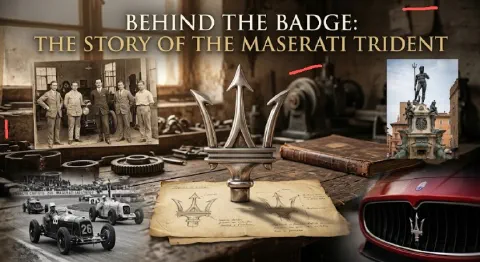
Maserati was founded in Bologna in 1914 by Alfieri Maserati, and run together with his brothers. Most of them were engineers and racing drivers. Mario Maserati was the exception: he had studied art at the Brera Academy in Milan, and when his brother Alfieri wanted a badge for the cars they were about to build under their own name, it was Mario who was asked to design it.
Neptune’s spear
The story told by Maserati itself is that Mario found his idea in Bologna’s Piazza Maggiore, at the Fountain of Neptune, where the sea god holds a three-pronged spear. A trident suited a racing car: strength, power, and a symbol of the city the company came from. The red and blue that the badge carried for most of its life are the colours of Bologna.
1926: first race, first win
The trident first appeared on the Tipo 26, the first car the brothers built entirely themselves. It made its debut at the Targa Florio in Sicily on 25 April 1926, with Alfieri Maserati at the wheel, and won its class. That first badge was a black trident on a white background in a rectangular silver frame.
From rectangle to oval
In 1931 the rectangular badge became an oval, which fitted better on curved radiators. Maserati also tells a second version of the story, linking the oval to the elliptical tubes of its Grand Prix chassis. Either way, the oval has been part of the badge ever since.
After the Orsi family bought the company in 1937, Maserati moved from Bologna to Modena. The trident went with it, and the brothers themselves returned to Bologna ten years later to found OSCA.
The Saetta
From 1963 the Quattroporte, and later the Ghibli, wore a variation on the C-pillar known as the Saetta: the trident with a lightning bolt beneath it. It became a Maserati signature in its own right.
2005 and 2020: refinement, not revolution
The badge has been simplified and stylised many times without losing its basic shape. In 2005, with the MC12, the side prongs were redrawn and the trident separated from the blue area at the bottom of the oval.
The latest change came in September 2020 with the MC20. The trident was restyled to look “more modern, balanced and elegant”, in Maserati’s words. On the C-pillar it lost both its oval frame and the Saetta lightning bolt, the badge went from three colours to two, and the finish changed from gloss to satin chrome.
Spotting the right trident on a classic
Because the badge changed in small steps, a later trident on an earlier car is easy to miss. Proportions of the prongs, the shape of the oval and the colour of the field all changed over time. As with any restoration, period photographs of the exact model and year are the best reference.
Sources
- Maserati: the logo
- Motor1: new Maserati logo (September 2020)
- Sports Car Digest: first 100 years of the Maserati trident
- MotorWebMuseum: Maserati moves to Modena with the trident brand